 Anglais
 Français
 Allemand
Aloha : L’ascension pour l’échafaud ! EN
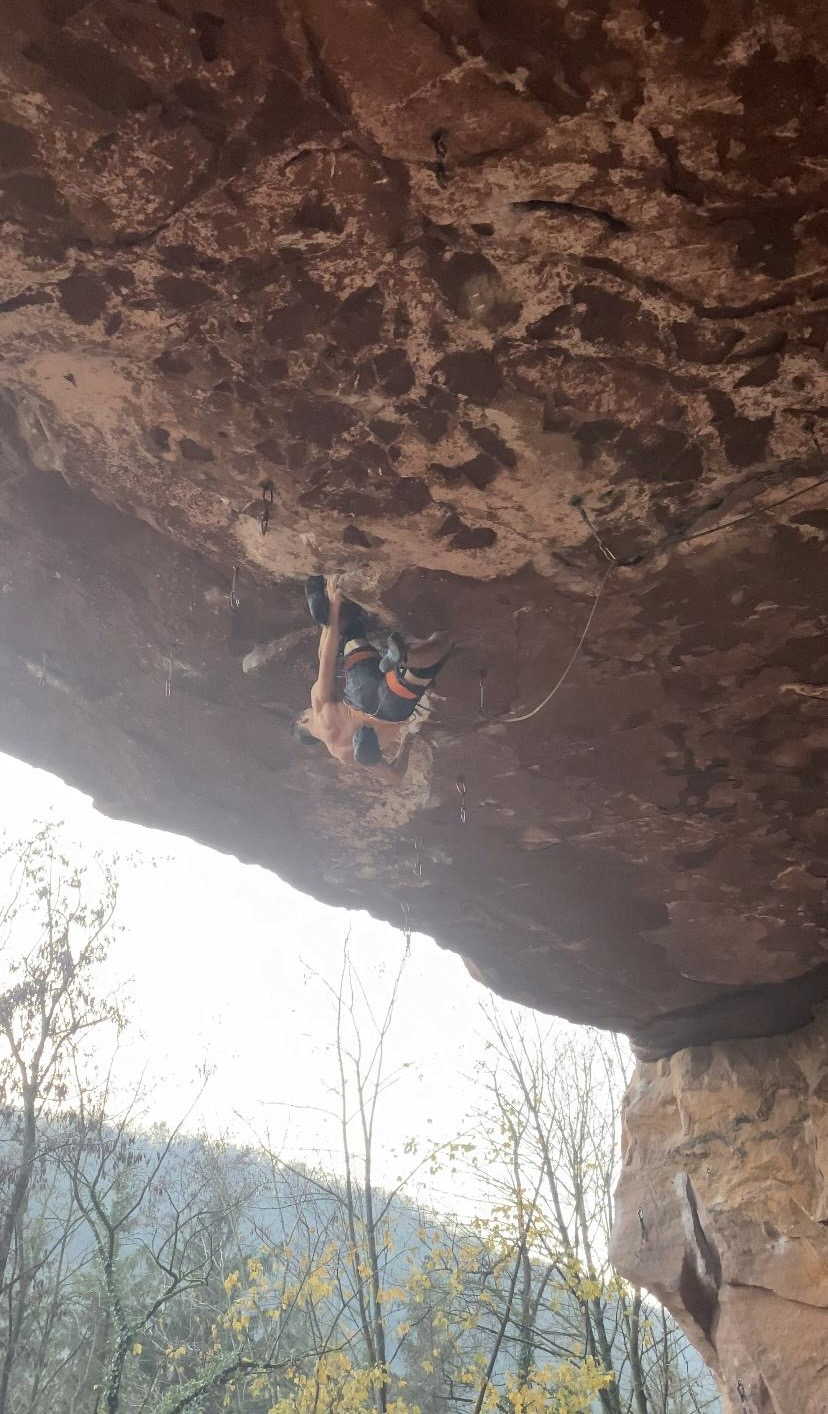
Il y a quelques mois de cela, en digne enfant du Kronthal, je retournai fouler ses terres lors de l'une de ces journées à l'atmosphère si singulière. Après un échauffement des plus sommaires, je me retrouvai comme à mon habitude sur la vire permettant d’accéder au plafond du Kronthal. Rien de bien particulier jusque-là. Cependant, un groupe d’Allemands vint très vite envahir le secteur. Sur le moment, je ne leur accordai qu’une attention distraite. Après tout, le Kronthal est depuis bien longtemps devenu une terre internationale. Mais quelque chose finit par attirer mon regard : l’un d’eux venait de s’élancer dans la mythique Aloha.
Cette vision fit aussitôt remonter le souvenir d’une conversation avec un certain AK qui, quelques jours auparavant m’avait parlé d’un jeune Hollandais enchaînant les essais dans la voie grâce à pas moins de quatre coincements de genou distincts. Comme souvent, un vernis narratif avait été appliqué à l’histoire. Néanmoins, en observant bien ce grimpeur je dus reconnaître qu’il existait bel et bien un repos genou d’une ingéniosité déconcertante. Si bon qu’il lui permit même, au beau milieu de la voie, d’ôter paisiblement son tee-shirt avant de repartir comme si de rien n’était. Une scène presque obscène pour quiconque avait déjà passé plus de trois secondes à suffoquer dans cette voie.
Au gré de la séance, je finis par lier conversation avec ce fameux Allemand. Il s’appelait Nils, venait de Sarrebruck et la réussite semblait à portée de doigts. Les sensations étaient là, les méthodes aussi et cela se confirma très vite puisqu’au cours de cette même journée il chuta à deux reprises dans le tout dernier mouvement.
À mesure que la lumière déclinait, les affinités se tissèrent avec une aisance inattendue. Au détour de discussions méthodologiques et des sempiternels débats sur les spécificités du Kronthal, nous scellâmes cette première rencontre en échangeant nos contacts, nous jurant avec cet enthousiasme teinté de vantardise toute gasconne de « regrimper vite ensemble ».
Puis le temps fila et ce moment se dilua peu à peu dans les méandres de ma mémoire …
Après quatre mois, je me retrouvai de nouveau au Kronthal. J’y croisai Amos qui m’apprit entre deux mots que Nils aurait finalement enchaîné Aloha une dizaine de jours plus tôt… presque en catimini. L'étonnement fut de taille. Comment un tel exploit avait-il pu passer inaperçu ? Dans nos contrées, une telle prouesse justifiait d'ordinaire son lot de chroniques, alimentait les conversations, suscitait l'incontournable débat sur les cotations, voire une polémique passionnée sur l'usage des genouillères.
Il m'apparut alors inconcevable de laisser ce fait d'armes sombrer dans les tréfonds des fables alsaciennes. Je dégainai donc mon téléphone pour adresser mes louanges au jeune vainqueur et l'inviter à s'épancher sur cette ascension.
Retour sur notre échange entre trajectoire personnelle et secrets d'une ascension silencieuse.
ST
Nils, hello and thank you for taking the time for this interview, and congrats on the send! Before talking about Aloha, could you introduce yourself in a few words?
Hi, and thanks to you for proposing this interview! I’m 23 years old and I’ve been climbing for about eleven years, maybe twelve. I’m currently studying in Saarbrücken. Before climbing, until I was around 12, I played football. Then at some point things changed, I don’t really know why, but at first, like everyone, I was mostly just happy to climb boulders, you know, the basic beginner thing where you’re just having fun finding a way up a block.
How do you go from that purely recreational and “fun” approach to the world of competition and more “serious” training?
At some point I joined the local team, and that’s when I started taking things a bit more seriously, training properly. I was 14 or 15. Honestly, I was what I’d call a “moderately successful” competitor. I managed to go to a few European youth cups, which is my biggest achievement in competition. It was fun, I gave everything I had, but I was never among the really strong ones. I stopped competing around 18 or 19.
What stands out when looking for information about you is how discreet your profile is: no 8a.nu, no Instagram, no articles or interviews. Is that a deliberate choice?
Yeah, it’s deliberate. I didn’t really like the climbing media bubble, this whole competitive aspect. When someone posts something, we constantly end up comparing ourselves to each other. And in my opinion it takes the focus away from what I want dto do „climb for my sake“. I think its good to let everyone climb the way they want, as long it doesn’t limits others!
With that kind of philosophy and this desire to stay away from social media, I imagine sponsorships and looking for brands to support you are very far from your priorities?
Yes, first of all, I don’t think I am strong enough for that. And today, I feel like, in sponsorship, it’s not really about „just“ supporting the climbing anymore. If you want serious sponsorship from the big climbing brands, you need to sell yourself/ be good at , be your own manager, know how to reach lots of people.
Supporting me isn’t especially interesting for them. I’d need to be good at building a social media profile, have lots of followers, the pressure to climb certain grades and that’s just not what I want.
At least it allows you to keep total freedom in your climbing. And you’ve used that freedom quite a bit by traveling lately, right?
Last year I focused on my studies, so I had to slow down. But during the two years before that, I spent most of my time outside, mainly between Spain and Norway with a few detours around. A period where sport climbing really took up all the space.
I saw that you climbed Chilam Balam (9a+/b, note: the grade is debated), is that your biggest project so far?
It’s clearly my biggest achievement in terms of grade, and probably also in terms of process. I stayed there for two months, maybe a bit more. After that, I did quite a few other smaller projects, but if there’s one that’s really personal to me, it’s Coup de Grâce (9a) in Switzerland. That route means a lot to me. Seven years ago, I saw someone climbing it and I told myself: “wow, that looks so good, I want to climb 9a one day.” At the time, that level was completely abstract to me, almost mythical. When I finally went there, it took me around one week of projecting. It’s funny to come full circle like that, to end up climbing a route that originally made you want to give everything. It was a really special experience.
How would you describe your climbing profile, your trademark on rock?
I’m definitely not a boulderer, that’s for sure (laughs). I often max out around solid 7C+, maybe 8B at absolute best if I really dedicated myself to it. My strength is more in routes: managing to link moves even when I’m completely boxed, being strategic, saving energy, adapting, climbing fast, finding tricks (kneebars, heel and toe hooks and such) to be efficient. No need to be the strongest (laughs). So my style is kind of that: not very powerful, rather messy, throwing myself from hold to hold, probably not very pretty to watch. And I clearly prefer steep overhangs and roofs.
And is Spain where you find the best terrain for that kind of climbing, or do you have other hidden paradises?
Yeah, for me the best spots are in Spain. Hard to point to one specific area. I really like limestone. Flatanger is great too, but it’s not comparable to Spain where you have so many incredible crags with different styles very close to each other.
Alright, let’s talk about Aloha now. Why did you choose that route specifically?
First because it’s close to home, and because it’s a roof (laughs). And then, when I started getting interested in routes in the 9th grade range, it was kind of a mystery. I had heard about Julius Westphal’s ascent, there were rumors around the route, almost a mystery. That’s what attracted me, because otherwise I didn’t really climb much in Alsace before. When I was younger I mostly went to Berdorf, or a bit further into France, or on the German side in the Palatinate. It’s not as good as Alsace, but it was closer to home.
What was it like the first time you tried Aloha?
It’s a pretty particular route. If you find the methods, the individual moves don’t feel that hard. But if I spend several burns/ check out goes in it, say thirty minutes in the roof, and then want to go back, I feel like my body is completely destroyed, even though the moves themselves don’t seem that hard. And it’s very, very technical, you really need to know how to move in three dimensions!
Could you describe the route section by section? How would you break it down and what stands out to you?
After the easy intro in the roof on good holds, you reach the first really striking move, going for the first crimp. It’s not the hardest move itself, but it’s a random move that requires strength and good positioning. Then the overall climbing in the roof is okay, but pretty pumpy. And then there’s the last boulder problem. I always thought it wasn’t the hardest part, but the final move, I fell there maybe ten times, maybe I’m exaggerating a bit, but really very often. Because there are five or six possible methods: with the heel hook, switching heel to toe to avoid cutting feet, jumping to this weird sloper to switch hands. I tried all the methods, I fell, changed methods, fell again, changed again. In the end, the best method for me was the “jump” version, paradoxically the most risky beta.
In terms of time invested, how many sessions did it take overall?
In total, I’d say five, six, maybe seven sessions spread over five months, something like that. Hard to say precisely, I didn’t keep a logbook!
Let’s talk methods and ethics. You introduced a new sequence by using a hold from the neighboring 8c (L’âme du Phoenix). Around here, ethics can be pretty strict about that, especially since the routes are close together, unlike Spain for example. Did you think about that, or did it just feel logical to you?
It felt logical to me, yeah, because taking good holds is logical (laughs). For me, that hold was clearly part of the line. I talked about it with Amos and we agreed. But well, if the community says that hold is excluded, then it’s excluded and I didn’t climb the route (Editor’s note: difficult to decide beforehand, since none of the previous ascensionists are local to directly give their opinion and nobody seemed to have thought of this idea before him). It would just be an easier version that I climbed. I don’t really have a strong opinion about it. If I had known beforehand, I would’ve tried without it. Sometimes it’s specified in the guidebook and that’s perfectly fine, often it’s useful if you want to create harder routes. For me it doesn’t change much, because I’m very confident in the knee-bar sequence that follows, I would’ve found another way. But if people think it changes the line too much, I’m totally comfortable with removing the hold. Everyone should be able to give their opinion, and if someone says “if I use that hold, it’s 8c+,” that’s fine with me.
You found an incredible no hands rest in the middle of the route. Friends who tried it told me the knee-bars are very, very technical. For you, does that change everything?
It makes a big difference, yes, but it’s very physical and very technical. You really need confidence in your knees because you’re on precarious positions. One knee-bar is a bit better than the other, but it’s still not an easy rest to take. The problem with my opinion on the grade is that it’s hard for me to judge because I’m pretty good at knee-bars, so I can use them well. But is the route easier because I use knee-bars, or because I’m simply good at that technique and my core strength is good? If lots of other climbers can use them and find that it makes things easier, then yes, the grade should probably go down. But it remains a complicated debate.
By the way, regarding the overall debate about kneepads in climbing…?
My opinion is that the sport evolves. Using knee-bars is very natural, especially in areas with big tufas where it was already natural even without kneepads back then. It’s not like I’m using a metal hook attached to my wrist. The sport progresses, and most of the hard sport climbs nowadays have been climbed with kneepads.
So what’s your feeling about the grade then?
I think it could be 9a. A soft 9a, but 9a. Really hard to say. Knee-bar skills help so much on this route. If it were climbed like the first ascensionists did it, I think it would be a very hard 9a. With the current methods, I’d say 9a, maybe 8c+, but more likely 9a.
What’s next project-wise, in Alsace or elsewhere?
I was super motivated to finish Aloha precisely because I want to try the 8c+ you did (Editor’s note: Labyrinthe de Pan). I think the combination would be amazing: starting from the 8b (Editor’s note: Rempart d’argile) into the 8c+. But the 8c+ still seems really burly to me, because the individual moves are, in my opinion, potentially harder than Aloha.
You find the moves in Aloha easier than the ones in Labyrinthe? That’s crazy to hear, because I did one burn in Aloha and maybe managed four or five moves out of ten or twelve, while I sent Labyrinthe de Pan (laughs).
Yeah! But obviously, the more you climb on a route, the more your perception of the difficulty changes, because you get used to the moves and they become fluid, even the ones that seemed hard at first. So it’s difficult to compare with a route you’ve only just started trying. But I still think it’s a bit harder. If the crux of the 8c+, the one from the crimp before going into the shoulder move, were at the end of the route instead of at the start, it would be significantly harder (laughs).
And the combination of Labyrinthe start plus Aloha finish, what do you think that would be?
The idea would be amazing: before going to the horn in the 8c+, traverse left instead of going up, do the traverse and finish in Aloha. That could be 9a+, maybe harder, I don’t know. I haven’t really tried it properly, but I think it’s already very hard. If you start from the 8b into the 8c+ you did, I think it’s already 9a, because you never really reach the slab with your feet, so you can’t really rest.
Another project elsewhere?
I have a huge project, but maybe it’s an unreachable goal (laughs). I tried Stoking the Fire (9b) the last two seasons at Santa Linya. I have all the moves dialled. But the route is pure power-endurance. Even though the individual moves feel okay, once you leave the ground after three quickdraws, you fall because you’re already way too pumped, at least for me (laughs). We’ll see what I can do there. It would clearly be a dream route.
Thank you very much Nils, and see you soon at Kronthal maybe, for a few good beta exchanges!
With pleasure, I definitely hope so! And if you can give me your beta for Labyrinthe, I’ll gladly take it, that would help me quite a lot.